


As a physician-turned-investor managing a biotech hedge fund, I’ve watched many smart colleagues (and investors in general) dive into the exciting world of stock charts. Patterns like “head and shoulders,” moving averages, or RSI indicators can feel sophisticated—especially with multiple screens lighting up your desk. When my daughter Hannah was a baby singing “Head, Shoulders, Knees, and Toes,” it always made me smile and think of those chart patterns. It’s a lighthearted reminder that while technical analysis has its fans and can be fun to explore, it’s not the approach I rely on for building wealth over time.
My View on Technical Analysis: It Has Limits
Don’t get me wrong—many talented traders use technical tools successfully, and I respect their skill. But in my experience, these methods primarily tell us what has already happened to a stock’s price, not necessarily what will happen next. To generate consistent returns year after year, I focus on understanding a company’s future potential through its fundamentals: earnings growth, competitive advantages, and intrinsic value.
Relying heavily on past price action can sometimes create overconfidence, leading to decisions driven more by patterns than by business realities. And while there are plenty of gurus teaching technical strategies, I’ve seen cases where the real beneficiary ends up being the gurus—through course sales or trading activity that benefits them more than their followers. That’s why I encourage investors to think critically about where advice is coming from.
One surprising lesson I’ve learned (backed by decades of market studies) is that the more actively you trade or monitor prices, the harder it often becomes to outperform simple, low-turnover strategies. Frequent checking can trigger emotional reactions—buying during euphoria or selling during temporary dips—which works against long-term success.
A Simpler Approach: Invest Like Planting a Tree
I prefer to keep things straightforward. Think of buying stocks like planting a tree: You research carefully upfront, choose quality “seeds” (companies) at reasonable prices, plant them, and then give them time to grow. You don’t need to dig them up daily to see if the roots are progressing. A quarterly review—when companies release earnings—is usually plenty, like giving the tree a gentle watering.
Constant trading in and out is like repeatedly uprooting and replanting the tree in hopes of faster growth—it rarely helps and often sets you back with taxes and fees. Obsessively watching daily prices is like staring at the sapling every hour, wishing it would hurry up. Patience, combined with solid initial research, tends to yield the best results.
A Real-Life Example: The Value of Patience with Amicus Therapeutics
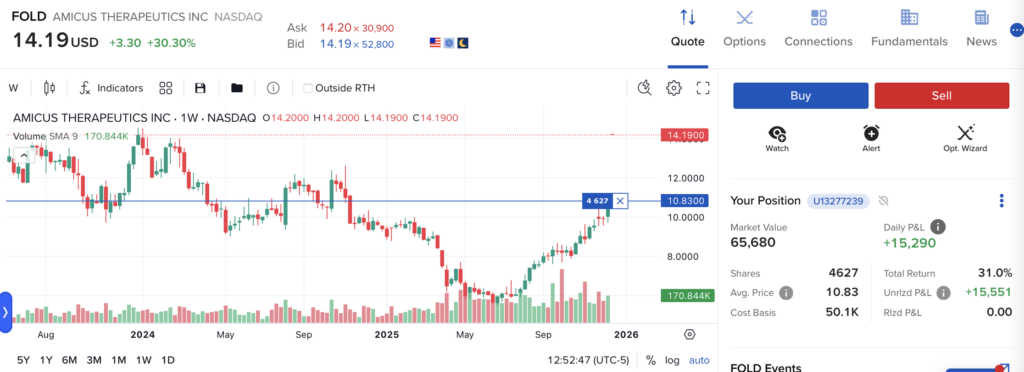
A couple of years ago, our biotech hedge fund took a modest position in Amicus Therapeutics (FOLD), a company focused on rare disease treatments. For the first two years, the stock traded below our purchase price—showing paper losses. But as long as you don’t sell during temporary setbacks, those losses remain unrealized. When you own a strong business bought at a fair valuation, the market tends to reward patience over time.
I viewed Amicus as a “stalwart”—a mature company past its hyper-growth phase but still with meaningful upside (roughly 25-40% based on my analysis). Major investor Perceptive Advisors had exited, signaling the explosive phase was likely over, but the fundamentals remained supportive. So we held steadily.
Then, BioMarin announced its intention to acquire Amicus for $4.8 billion. The stock surged over 30% on the news. With most of the expected upside now realized, we exited the position and captured solid gains.This wasn’t our biggest winner—some holdings have multiplied 4x or more—but it beautifully illustrates the power of understanding what you own, buying at reasonable prices, and allowing time to work in your favor.
Final Thoughts for Busy Physician Investors
As physicians with demanding schedules, we especially benefit from an uncomplicated, evidence-based approach: Focus on quality businesses, reasonable valuations, and long holding periods. Skip the daily noise, trust the process, and let compounding do its magic.I’d love to hear your experiences—do you lean toward charts and active trading, or do you prefer a more patient, fundamentals-driven style? Share in the comments below.
Join our Skool community page at https://www.skool.com/evergrowthbiohealthcarecapital
Schedule a free consultation with me to see if we are the right fit https://calendly.com/drharveytran/evergrowth-introduction?month=2025-05.
You can check out our Fund Presentation below:
To your health, retirement, and superior returns,
Harvey Tran, MD | Chief Investment Officer, Evergrowth BioHealthcare Capital
Follow me on Social Media:

Enjoyed This? Stick Around! Subscribe to my newsletter for more insights on using your MD advantage in biotech investing.

Check out our Fund Presentation and our Skool Community Page.
Disclaimer: This blog is for educational and informational purposes only. It’s not a recommendation to buy, sell, or hold any stock. Always consult your investment advisor and do your due diligence before investing. In working smarter rather than harder, I wrote an initial draft based on my knowledge, experience, and insight. I then leverage AI to polish up my article into this format.
Disclosure: I previously owned FOLD through our biotech hedge fund (Evergrowth BioHealthcare Capital). I liquidated our position today.
More Reads for You:
- It’s Not About Timing the Market. It’s About Trusting the Process.

- 📊 June 2026 Investor Update – Financial Report Released
- The Secret That Wall Street Doesn’t Want You to Know for Retirement

- Exceptional Performance and Holiday Greetings

- Why I Prefer Fundamentals Over Charts: A Physician-Investor’s Perspective on Long-Term Investing

- An Integrated BioSci Investing Approach for Alpha Returns